← Example projects

Available now Packaging · OEM panel

A checkweigher HMI you can open, change and ship.

A complete operator panel for an inline checkweigher, laid out for an 800 × 550 touch screen. Live weight, statistics, a recipe queue and five setup pages behind an ADMIN PIN, in English and Dutch. Import the zip and it runs, no PLC needed.

80 kB · needs NEXT HMI 1.1.0 or later · MIT-0, source on GitHub
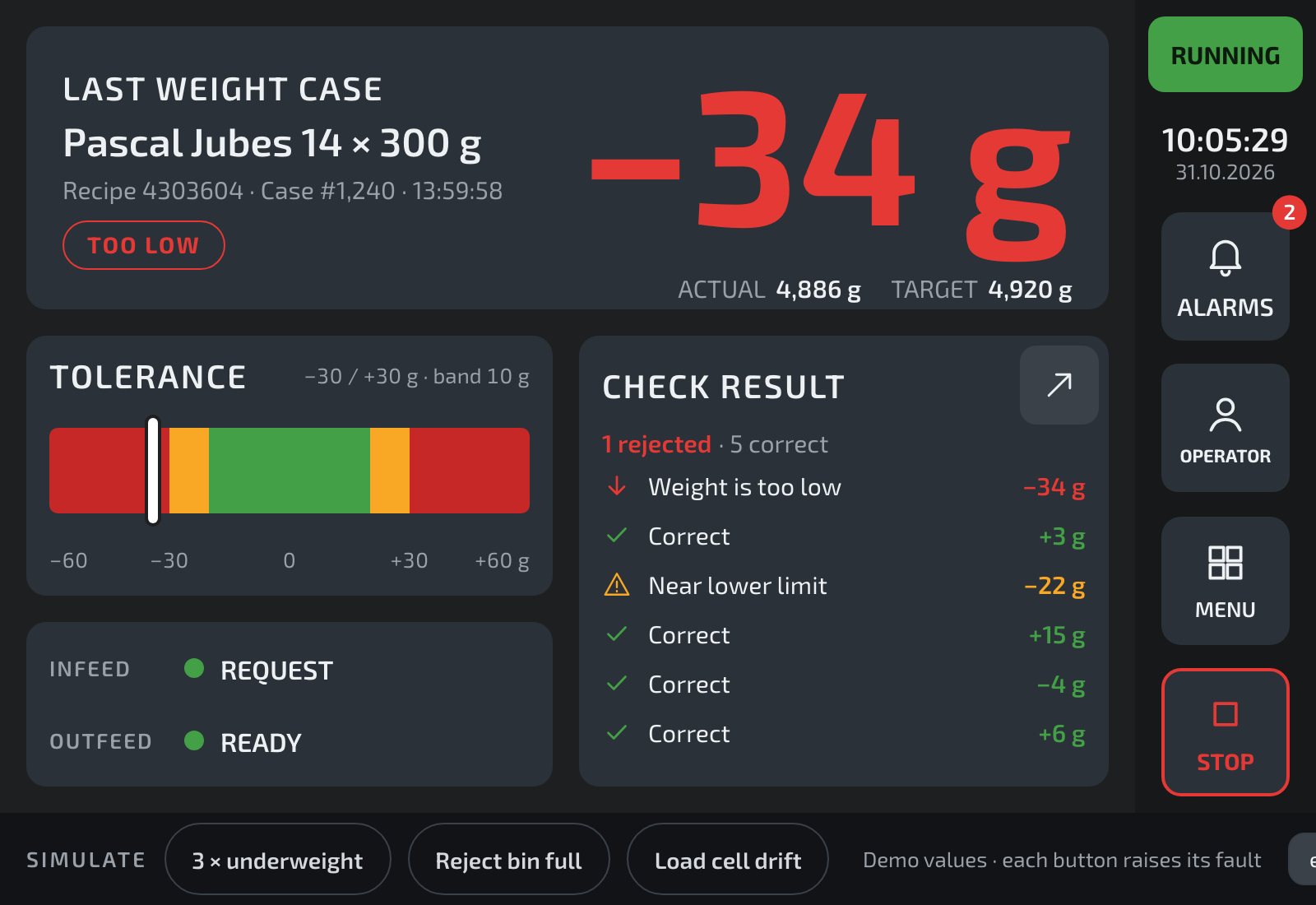
The checkweigher's run screen: the last case, Pascal Jubes 14 × 300 g, came out 34 g under its 4,920 g target and is flagged Too low; a tolerance bar shows where it landed, a check-result list shows one reject and five correct cases, infeed and outfeed are green, and a side rail carries the Running state, the clock, Alarms with a badge of 2, Operator, Menu and Stop.
Built for the bad day

Three cases too light, and the screen says so.

A demo that only shows a happy line proves little. The footer has a Simulate bar: each button raises one real fault, so you can see how the screen behaves when the line stops at 2 a.m.

  • 3 × underweight halts the line. The state tile turns red and reads Halted, a banner names the cause and links to the alarm, and Stop becomes Resume.
  • Reject bin full and Load cell drift raise warnings that wait in the alarm list without stopping production.
The run screen after the 3 × underweight simulation: a red banner reads Halted · Three underweight cases in a row with a link to the alarm, a toast confirms the line halted, the state tile reads Halted in red, infeed shows Blocked, and the Stop button has become Resume.
Halted, with the reason on screen. One tap in the Simulate bar; the banner, the toast, the state tile and the Resume button all come from the project's own alarm and bindings.
Twelve screens, one 800 × 550 frame

Everything an operator and a service engineer need.

The Statistics page: tiles for 1,240 total cases, 1,225 accepted, 15 rejected, a mean weight of 4,920.7 g, a standard deviation of 11.5 g and a throughput of 40 cases a minute, above a deviation trend of the last 20 cases and a weight distribution histogram.
Statistics. Mean, spread, rejects and throughput, with a trend and a histogram.
The Alarms & Events page with All, Active (2) and History filters: an info alarm I-301 Zeroing required, a warning W-202 Load cell drift marked New, and an earlier W-202 that has cleared, above a wide Acknowledge button.
Alarms. Active and history, one wide Acknowledge button.
The Recipes page: recipe 4303604, Pascal Jubes 14 × 300 g, is active at 1,240 of 2,000 cases with a progress bar and a 4,920 g target; three more recipes are queued below it with their targets and planned quantities.
Recipes. The active order with its progress, the next ones queued.
The Admin PIN dialog over the run screen: an Enter PIN field above a large on-screen touch keypad.
Setup behind a PIN. Operators run it; only ADMIN changes it. Demo PIN: 1234.
Setup, Product / Tolerances: the recipe 4303604 is locked, with target weight 4,920 g, lower limit −30 g, upper limit 30 g, near-limit band 10 g and tare 180 g as large touch fields; the side rail shows Admin.
Five setup pages. Tolerances, calibration, reject unit, conveyor, save.
The run screen in Dutch while the line is halted: Gestopt · Drie dozen op rij te licht, Laatst gewogen doos, Tolerantie, Controleresultaat, and Hervatten on the resume button.
English and Dutch. All 235 texts in one CSV, switched from the footer.
Yours to take apart

Start your next panel from this one.

A folder of plain JSON and CSV, licensed MIT-0: copy it, change it, ship it. To try it, import the zip in the Manager under Projects → Import project from zip (NEXT HMI 1.1.0 or later).

  • Connect a real machine: point the CW datasource at your OPC-UA server, and remove the start-up event that seeds the demo values.
  • Reuse the widgets: histogram, trend, tolerance bar and two bar charts, ready for any project.
  • Ship it on your own hardware: with your branding, for €149 per installation, once, excl. VAT.
Building a machine?

Ship your machine with a panel like this.

All example projects·OEM pricing